Rent Payment Apps vs Bank Transfers in India: Which Is Better?
The era of monthly rent anxiety and frantic bank visits is over. However, a new challenge emerged in early&nbs...
May 7, 2026 • RentenPe




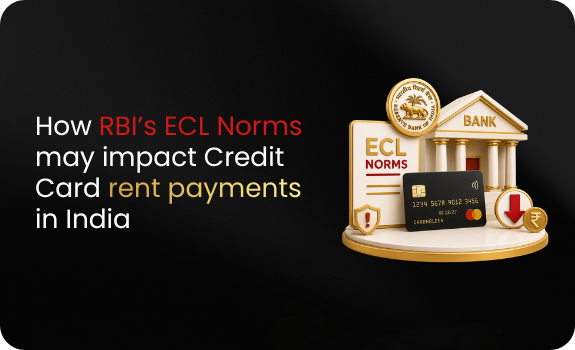
The urban Indian tenant enjoyed a clever financial loophole: using credit cards to pay monthly rent. It was the ultimate win-win. You could earn massive reward points, unlock milestone cashbacks, and essentially borrow your rent interest-free for up to 45 days.
However, RBI’s shift to stricter Expected Credit Loss (ECL) norms and related payments rules ended the rent‑by‑credit‑card free ride: Credit‑card rent volumes fell about 74% year‑on‑year in 2025, single‑day card processing peaks reached roughly ₹6,400 crore before restrictions, and typical convenience/processing fees now range about 1–3% (e.g., ₹300–₹900 monthly on a ₹30,000 rent) changes that turned a previously reward‑earning, interest‑free flow into a higher‑cost transaction.
By understanding the RBI ECL norms impact, you can see why your monthly rent has suddenly become a high-cost transaction rather than a rewarding hack.
Understanding the Shift: What are RBI ECL Norms?
Under the previous incurred loss model, banks provided for losses only after a default occurred.
The RBI ECL norms impact requires financial institutions to look forward, estimating potential losses and setting aside capital at the moment a loan or a credit card limit is issued.
Since rent payment by credit card is technically an unsecured credit draw, it falls into a higher-risk category under the new framework.
Indian banks have begun increasing their capital buffers by 15–20% for unsecured portfolios to comply with RBI fintech regulations, leading to a direct squeeze on low-margin services like rent transfers.
How RBI ECL Norms Affect Credit Card Rent Payments
The primary question for many is: how RBI ECL norms affect credit card rent payments on a daily basis? The answer lies in the cost of capital.
As banks face higher provisioning costs, they are no longer able to subsidize the interest-free period for high-value transactions like rent.
Increased Fees: In 2025, we have seen credit card rent payment charges climb from a standard 1% to as high as 2.5% across major issuers.
Reward Devaluation: To maintain fintech compliance India, many issuers have completely removed rent payments from reward point eligibility to protect their Net Interest Margins (NIM).
Strict Limits: New RBI guidelines for fintech apps now often require a cooling-off period between transactions to prevent credit cycling.
The Role of Online Rent Payment Apps
For users of popular online rent payment apps and rent payment apps in India, the interface remains simple, but the backend is more rigorous.
To facilitate secure online rent payments, platforms are now mandated to collect and verify PAN details of landlords and valid rental agreements for any transaction limit.
These digital rent payments India are no longer just convenience tools; they are highly monitored financial movements.
Data from the first half of 2025 indicates that transaction volumes for credit card based rent payments have stabilized as yield-chasing users move away due to higher fees, leaving only those who truly need the liquidity.
Can You Pay Rent with a Credit Card in India in 2026?
The short answer is: Yes, you can still pay rent with credit card accounts, but the financial math has changed entirely.
The Cost Factor: Between the platform convenience fee, the bank’s rental surcharge, and the 18% GST on those fees, the effective cost of paying a ₹50,000 rent can now exceed ₹1,500.
The Risk Factor: Under the RBI ECL norms, frequent high-value rent payments that aren't immediately cleared can negatively impact your internal credit score with the bank, as it signals a high expected loss profile.
Conclusion: Navigating the New Norms
The move toward RBI ECL norms is a sign of a maturing, safer financial market.
While it removes the perks of credit card rent payment India, it ensures that banks remain solvent during economic downturns.
For consumers, the strategy for 2026 is clear: use online rent payment apps for their intended purpose of convenience and emergency liquidity, but avoid using them as a long-term debt tool or a rewards generator.
FAQ
1. Why are rewards on rent discontinued?
Under RBI ECL norms, banks must reserve capital for risk upfront. To offset these costs for unsecured rent spends, banks have scrapped all rewards.
2. Is paying rent by card still interest-free?
Technically yes, but fees now total ~3%. It is no longer free but a high-cost liquidity tool, as surcharges outweigh the 45-day credit benefit.
3. How do ECL norms impact my credit score?
High-value rent signals liquidity stress to banks. This raises your expected loss profile, potentially limiting future credit or loans.
4. Why is a rent agreement mandatory?
To meet fintech compliance, the RBI requires proof for transactions over ₹50k. This stops credit cycling and ensures transfers are legitimate.
The era of monthly rent anxiety and frantic bank visits is over. However, a new challenge emerged in early&nbs...
May 7, 2026 • RentenPe
In 2025, India’s digital payment system accomplished an impressive milestone: the Unified Payments Interface (UPI) processed&...
April 30, 2026 • RentenPe

The way we live & work in India is changing rapidly, & it is evident in our urban rental market.&...
April 24, 2026 • RentenPe

In the middle of the month, it feels like money runs out before the end of the month even in metros&...
April 7, 2026 • RentenPe

Every month starts the same way. Salary comes in, and almost immediately, a big part of it goes out as&nb...
March 27, 2026 • RentenPe

UPI vs. Credit Card: Best Way for Tenants to Pay Rent Before getting into which one is better, it helps&n...
March 20, 2026 • RentenPe

IntroductionPaying rent used to happen in a very different way. Many tenants would give cash or hand over a&nb...
March 18, 2026 • RentenPe

When a property becomes vacant, most landlords want to fill it quickly. Calls start coming in, people visit th...
March 12, 2026 • RentenPe

Most people treat rent like a routine bill. Something that leaves your account every month without much thought.&nb...
March 6, 2026 • RentenPe

Paying rent with a credit card once felt like a backup option people used only in emergencies. Now it’s a...
February 27, 2026 • RentenPe
For most tenants, rent is the biggest fixed expense every month. But handling the payment itself hasn’t always ...
February 20, 2026 • RentenPe

How Exactly Does a Credit Card Work?A credit card is a payment tool that lets you spend money that you&nb...
February 18, 2026 • RentenPe

The rent date somehow always seems to come when things are tight. Just as you get comfortable, the date a...
January 20, 2026 • RentenPe

Unlock the power of gamification with RentenPe – India’s First Rent Credit Score! Discover how smart rent payments,...
December 5, 2025 • RentenPe

Want to make your parents proud? Pay rent the smart way with RentenPe! Build your rent credit score, earn ...
December 2, 2025 • RentenPe

For tenants across India, paying rent with a credit card has always been a smart choice — whether for man...
November 18, 2025 • RentenPe

For tenants across India, paying rent with a credit card has always been a smart choice — whether for man...
November 25, 2025 • RentenPe

Paying rent every month can seem like money going down a drain, with no returns. For many tenants, it is&...
November 21, 2025 • RentenPe

Renting a home based on a handshake is a huge risk. It sounds so straightforward and easy, until something&nbs...
November 14, 2025 • RentenPe

Your Rent Is More Valuable Than You Think Every month, millions of Indians pay rent — money that leaves t...
November 13, 2025 • RentenPe

Every month, millions of Indians pay rent — money that leaves their account with no visible return. But what&n...
October 30, 2025 • RentenPe
Imagine you’re a young professional who has just moved to a new city for the first time for a job. A...
October 27, 2025 • RentenPe

In today’s fast-paced India, where a significant portion of the population is under 40, many individuals migrate fr...
October 27, 2025 • RentenPe

Paying rent online in India has never been easier. With RentenPe, you can pay rent via credit card, UPI, ...
October 20, 2025 • RentenPe

India has always been a land of firsts — breaking barriers and setting global benchmarks in innovation. From s...
October 20, 2025 • RentenPe

In 2025, India’s investment landscape is evolving rapidly, with innovative startups reshaping industries and unlocking new&nb...
October 14, 2025 • RentenPe